
The Harrison Grandelli Team, a residential real estate group at CORE, maintains this Lower East Side neighborhood guide. We put it together to help clients understand what sets Manhattan's downtown east side apart: its nineteenth-century tenement blocks and landmark synagogues, the Essex Market, the East River waterfront, and the everyday rhythm of Orchard, Essex, Delancey, and East Houston Streets.
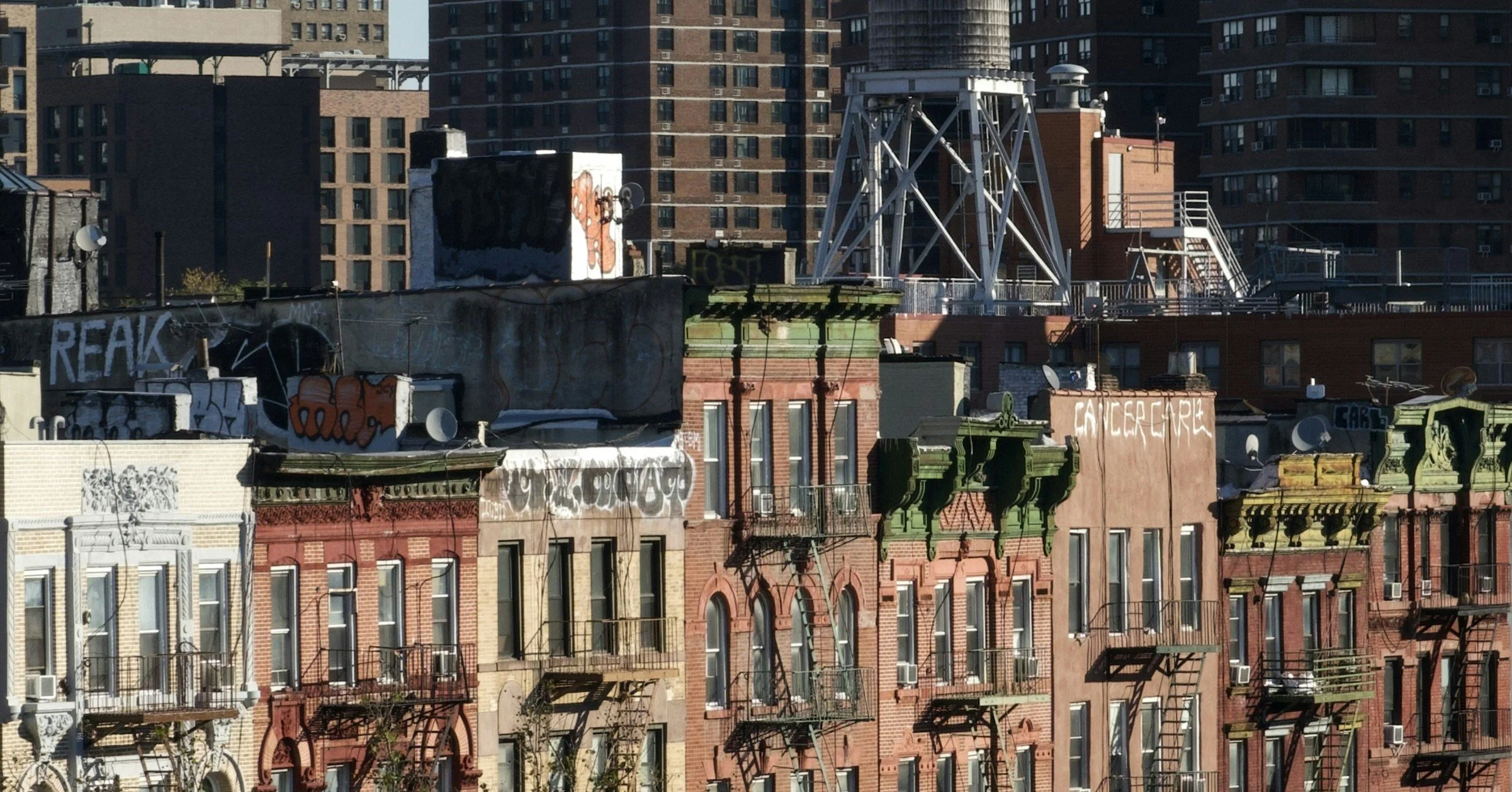
The Lower East Side runs from the Bowery to the East River below Houston Street. Five- and six-story brick tenements with fire escapes still line most of its western blocks, alongside synagogues, settlement houses, and storefront delis that have operated for more than a century. Toward the river and around Essex Crossing, larger co-op complexes and newer condominium and rental towers fill out the map.
Summary
Today, the Lower East Side is defined by:
Housing that mixes tenement walk-ups and co-ops with large postwar co-op complexes and newer condominium and rental towers near Essex Crossing and the river
Essex Market and the Essex Crossing development around Delancey and Essex Streets
Cultural anchors including the Tenement Museum, the Museum at Eldridge Street, and the International Center of Photography, with the New Museum just north of Houston on the Bowery
Dining and nightlife on Orchard, Ludlow, Rivington, Clinton, and East Houston Streets
Subway access on the F, J, M, Z, B, and D, with the Williamsburg Bridge's bike and walking paths to Brooklyn
History
The area was originally Lenape land. In the colonial era it was farmland, including the large estate of the De Lancey family, whose name survives in Delancey Street. After the Revolution the estate was seized and divided into lots, and the street grid filled in during the early nineteenth century.
From the 1840s, landlords built rows of narrow tenements, many on single 25-by-100-foot lots. The building at 97 Orchard Street, completed in 1863 and now part of the Tenement Museum, shows how those buildings were laid out and later altered under the city's housing laws of 1879 and 1901. Synagogues, churches, settlement houses, and newspaper offices filled the surrounding blocks. The Eldridge Street Synagogue opened in 1887, Lillian Wald founded the Henry Street Settlement in 1893, and the Jewish Daily Forward built its ten-story headquarters on East Broadway in 1912.
The Williamsburg Bridge opened in 1903, and Delancey Street was widened as its approach. Seward Park, opened the same year, included one of the city's first municipal playgrounds. Mayor Fiorello La Guardia opened the Essex Street Market in 1940 to move pushcart vendors indoors. Large co-op complexes rose along Grand Street in the 1930s and 1950s. Essex Crossing, built from 2015 on city-owned parcels around Delancey Street, brought a new Essex Market (2019), housing, offices, and a park.
Boundaries
The Lower East Side has no single legally fixed outline. Brokers, maps, and civic sources use closely related edges. The boundary we use in this guide is:
North: East Houston Street (toward the East Village)
South: Canal Street and East Broadway (toward Chinatown and Two Bridges)
West: the Bowery (toward Nolita and Chinatown)
East: the East River (FDR Drive and East River Park)
Primary ZIP code: 10002. The area falls in Manhattan Community District 3.
Fuzzy edges: Chinatown and Two Bridges overlap the south and southwest, and the blocks between the Bowery and Allen Street are often mapped with Chinatown. Some listings use "LES" for blocks north of Houston in the East Village.
Real Estate & Prices
The Harrison Grandelli Team works across Lower East Side walk-ups, co-ops, and condominiums. Tenement walk-ups and small co-ops dominate the western blocks. Large co-op complexes run along Grand Street, and newer condominium and rental towers stand near Essex Crossing and the waterfront. Layouts, amenities, and closing norms differ sharply between these building types.
Sales (NYC Department of Finance, October 2025 – September 2026)
Within the boundary used in this guide, residential sales recorded by the city from October 2025 through September 2026 had a median price of $990,000 across 167 sales. By type, the median was $745,000 for co-ops (95 sales) and $1,500,000 for condominiums (72). These figures count recorded co-op, condominium, and one- to three-family house sales. They leave out sales of whole rental buildings and count a purchase covering several tax lots once. They also exclude limited-equity co-op sales, non-home units such as storage, parking and staff rooms, sales under $100,000, small transfers on units that also recorded a market sale, and transfers that aren't home sales, such as commercial units and multi-property deals. Recorded sales lag closings by weeks to months, so the most recent months may be undercounted. Figures are rounded to the nearest $1,000.
Source: NYC Department of Finance recorded sales, October 2025 – September 2026.
Rent and Time on Market (StreetEasy, September 2026)
The median asking rent was $5,200 a month, and sale listings spent a median of about 123 days on market.
Source: StreetEasy Data Dashboard, September 2026.
These numbers describe a wide price band. Medians here move with the share of new-condo closings versus walk-up co-op sales in a given period.
Notable Restaurants & Food Scene
Katz's Delicatessen (205 East Houston Street): Delicatessen open since 1888, known for hand-cut pastrami.
Russ & Daughters (179 East Houston Street): Appetizing shop open since 1914, with smoked fish, caviar, and bagels. Its café is at 127 Orchard Street.
Yonah Schimmel Knish Bakery (137 East Houston Street): Knish bakery open since 1910.
Essex Market (88 Essex Street): Public market with butchers, fishmongers, produce stands, and prepared-food counters.
Dirt Candy (86 Allen Street): Amanda Cohen's vegetable-focused tasting-menu restaurant.
Wildair (142 Orchard Street): Small-plates restaurant and wine bar from Jeremiah Stone and Fabián von Hauske Valtierra.
Orchard, Ludlow, and Clinton Streets carry most of the newer restaurants, while East Houston Street holds the century-old delis.
Sources: restaurant websites (checked October 2026). Hours change, so confirm before visiting.
Parks & Outdoor Spaces
East River Park: Waterfront park along the FDR Drive, being rebuilt for the East Side Coastal Resiliency project. As of October 2026, the section south of East Houston Street is open, with ballfields, tennis and basketball courts, lawns, and the amphitheater. The northern section remains closed for construction, with reopening expected in phases through 2027 or later. Access is via the Delancey Street and Corlears Hook pedestrian bridges and Pier 42.
Seward Park (Essex Street and East Broadway): Neighborhood park opened in 1903, with a playground and the Seward Park branch library across the street.
Sara D. Roosevelt Park (Chrystie to Forsyth Streets, Houston to Canal): Long, narrow park with ball courts, gardens, and community spaces.
Corlears Hook Park: Small park at the foot of Grand Street by the river.
Pier 42: About eight acres of waterfront open space between Montgomery and Jackson Streets, with lawns, paths, and a playground. Its final phase opened in July 2024.
Schools & Education
Public schools are operated by the NYC Department of Education, mostly Community School District 1, with some southern and western blocks in District 2. Listing a school here is not a recommendation or a ranking. Check programs, admissions, and zoning on schools.nyc.gov and MySchools; zones change.
P.S. 42 Benjamin Altman: PK–5, 71 Hester Street. https://www.schools.nyc.gov/schools/M042
P.S. 142 Amalia Castro: PK–5, 100 Attorney Street. https://www.schools.nyc.gov/schools/M142
University Neighborhood Middle School: 6–8, 220 Henry Street. https://www.schools.nyc.gov/schools/M332
Transit & Getting Around
F: Delancey Street–Essex Street, East Broadway, and Second Avenue (at Houston Street)
J / M / Z: Delancey Street–Essex Street and Bowery
B / D: Grand Street (Chrystie Street)
NYC Ferry: Corlears Hook landing, on the South Brooklyn route
The M14A Select Bus Service runs down Essex Street to Grand Street, and the M14D Select Bus Service runs down Columbia Street toward Delancey Street. The M21 crosses on East Houston Street, the M9 runs along East Broadway, and the M15 runs on Allen and Pike Streets. The Williamsburg Bridge has paths for cycling and walking to Brooklyn.
Shopping & Retail
Orchard Street: Boutiques, galleries, and long-running shops along the former garment and dry-goods street.
Essex Market and Essex Crossing: Groceries, a supermarket, a movie theater, and shops around Delancey and Essex Streets.
Grand Street: Bakeries, delis, and everyday retail near the co-op complexes.
East Houston Street: Restaurants and retail at the East Village edge.
Culture, Arts & Nightlife
Tenement Museum (visitor center at 103 Orchard Street): Restored apartments at 97 and 103 Orchard Street and walking tours on the history of tenement life.
Museum at Eldridge Street (12 Eldridge Street): Museum in the 1887 Eldridge Street Synagogue, restored in 2007, with a stained-glass east window by Kiki Smith and Deborah Gans (2010).
International Center of Photography (79 Essex Street): Photography museum at Essex Crossing.
New Museum (235 Bowery at Prince Street, just north of the boundary): Contemporary art museum in a stacked-box building by SANAA (2007). An OMA-designed expansion next door opened in March 2026, doubling its gallery space.
Henry Street Settlement's Abrons Arts Center (466 Grand Street): Theater, dance, and visual arts.
Galleries: Many small and mid-sized contemporary galleries are spread along Orchard, Eldridge, and Forsyth Streets.
Nightlife is concentrated on Ludlow, Orchard, Rivington, and Clinton Streets, with cocktail bars, music rooms, and late kitchens.
Historic Landmarks & Notable Features
Eldridge Street Synagogue (12 Eldridge Street): Moorish Revival synagogue by the Herter Brothers, completed in 1887, a National Historic Landmark.
Forward Building (175 East Broadway): Ten-story Beaux-Arts tower by George A. Boehm, completed in 1912, with relief portraits on its façade.
Henry Street Settlement (263–267 Henry Street): Federal-style row houses where Lillian Wald founded the settlement and visiting-nurse service.
Bialystoker Synagogue (7 Willett Street): Fieldstone building from 1826, originally a Methodist church.
97 Orchard Street: 1863 tenement preserved by the Tenement Museum.
Williamsburg Bridge: Steel suspension bridge by Leffert L. Buck, opened in 1903.
Housing & Daily Logistics
The Lower East Side's housing ranges from tenement walk-ups to full-service towers. Essex Crossing and the river-adjacent buildings add elevators, amenities, and larger floor plates, while walk-ups and small co-ops offer a broader price band with fewer services. Large co-op complexes on Grand Street have their own board rules and processes.
In our experience, apartment, Essex Market, subway, and the restaurant streets often fall within a short walk of each other. Co-op board requirements and condo bylaws are part of our diligence on almost every purchase.
About the Harrison Grandelli Team
As a residential group at CORE, we work across Manhattan and Brooklyn, including Lower East Side walk-ups, co-ops, and condominiums. We maintain this guide as part of helping clients understand the neighborhood in depth. If you're thinking about a purchase or rental here, we'd be glad to share what we know on the ground.