
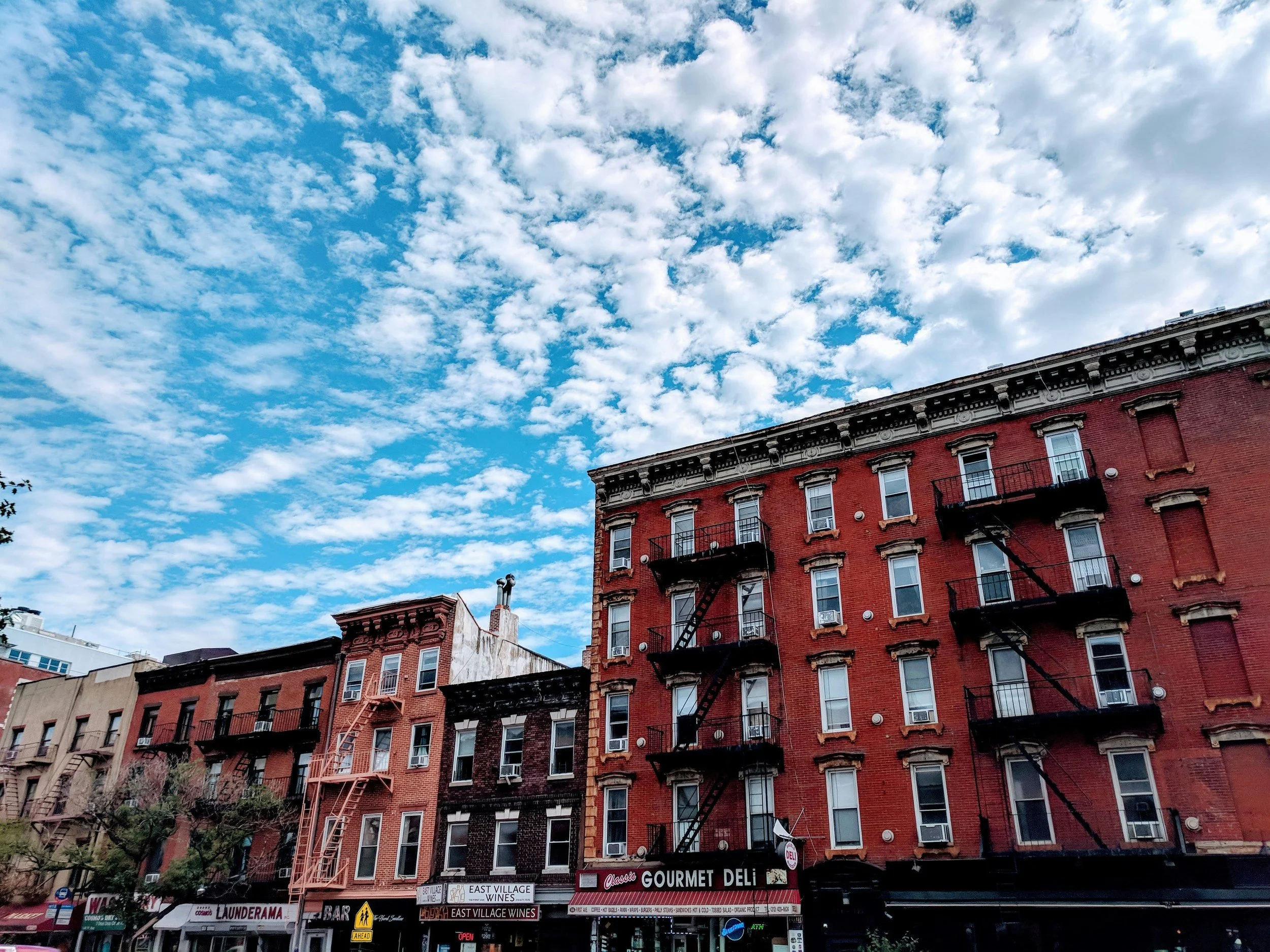
The Harrison Grandelli Team, a residential real estate group at CORE, maintains this East Village neighborhood guide. We put it together to help clients understand what sets Manhattan's East Village apart: its tenement and row-house blocks, Tompkins Square Park, its theaters and community gardens, its housing stock, and the everyday rhythm of Avenue A, First and Second Avenues, and St. Marks Place.
The East Village runs from the Bowery and Third Avenue to the East River between Houston and 14th Streets. Most blocks are lined with five- and six-story walk-ups. A few side streets keep Greek Revival row houses, churches from the Federal era stand near Second Avenue, and community gardens fill lots east of Avenue A. The eastern section, between Avenues A and D, is often called Alphabet City.
Summary
Today, the East Village is defined by:
Housing dominated by tenement walk-ups, small co-ops and condominiums, and scattered townhouses, with larger elevator buildings on the avenues
Tompkins Square Park as the central green, with dozens of community gardens east of Avenue A
Commercial streets on Second Avenue, First Avenue, Avenue A, and St. Marks Place
Cultural anchors including La MaMa, the Nuyorican Poets Café, Performance Space New York, Anthology Film Archives, and Cooper Union at the western edge
Subway access on the 6, L, and F, with the N, R, and W just west and Union Square a short walk northwest
History
The area was originally Lenape land. In the 1650s it was part of the “bouwerij” (old Dutch for “farm”) of Peter Stuyvesant, director-general of New Netherland, which gave the Bowery its name. Stuyvesant was buried beneath his family chapel, on the site where St. Mark's Church in-the-Bowery was built in 1799. Stuyvesant Street, which runs at an angle to the grid, follows an old farm lane.
Row houses filled the streets in the 1830s and 1840s, and Tompkins Square opened in 1834. From the mid-nineteenth century, builders replaced many houses with tenements. German-language institutions such as the 1884 Ottendorfer Library and the Deutsches Dispensary on Second Avenue date from this period, as do St. George Ukrainian Catholic Church, the Polish National Home, and other churches and social halls along Second Avenue and East 7th Street. In the early twentieth century, Second Avenue became the Yiddish Theater District, and the 1926 Yiddish Art Theatre survives today as the Village East by Angelika.
From the 1950s and 1960s, the name East Village came into use for the blocks north of Houston, and Off-Off-Broadway theaters, poetry readings, and music clubs grew up on Second Avenue, the Bowery, and East 4th Street. Community gardens took root on vacant lots in the 1970s and 1980s. The Landmarks Preservation Commission designated the East Village/Lower East Side Historic District and the East 10th Street Historic District in 2012.
Boundaries
The East Village has no single legally fixed outline. Brokers, maps, and civic sources use closely related edges. The boundary we use in this guide is:
North: East 14th Street (toward Union Square and Stuyvesant Town)
South: East Houston Street (toward the Lower East Side)
West: the Bowery and Third Avenue (toward NoHo and Greenwich Village)
East: the East River (FDR Drive and East River Park)
Primary ZIP codes: 10003 (roughly west of First Avenue) and 10009 (east of First Avenue). The area falls in Manhattan Community District 3.
Fuzzy edges: Alphabet City (Avenues A–D) is sometimes treated separately. The blocks west of the Bowery and Third Avenue are NoHo and Greenwich Village, and some listings use "East Village" for blocks south of Houston.
Real Estate & Prices
The Harrison Grandelli Team works across East Village walk-ups, co-ops, and condominiums. Tenement walk-ups dominate many side streets. Elevator co-ops and small condominiums appear on the avenues, and townhouses are scattered, especially on East 10th, 11th, and 12th Streets. Renovation quality and building services vary widely, so unit- and building-level diligence matters here.
Sales (NYC Department of Finance, October 2025 – September 2026)
Within the boundary used in this guide, residential sales recorded by the city from October 2025 through September 2026 had a median price of $900,000 across 184 sales. By type, the median was $650,000 for co-ops (106 sales) and $1,488,000 for condominiums (76). Two townhouse sales are included in the total but too few for a separate median. These figures count recorded co-op, condominium, and one- to three-family house sales. They leave out sales of whole rental buildings and count a purchase covering several tax lots once. They also exclude limited-equity co-op sales, non-home units such as storage, parking and staff rooms, sales under $100,000, small transfers on units that also recorded a market sale, and transfers that aren't home sales, such as commercial units and multi-property deals. Recorded sales lag closings by weeks to months, so the most recent months may be undercounted. Figures are rounded to the nearest $1,000.
Source: NYC Department of Finance recorded sales, October 2025 – September 2026.
Rent and Time on Market (StreetEasy, September 2026)
The median asking rent was $4,995 a month, and sale listings spent a median of about 65 days on market.
Source: StreetEasy Data Dashboard, September 2026.
These numbers describe a wide price band. The median moves with the mix of walk-up studios, larger co-ops, and townhouses that close in a given period.
Notable Restaurants & Food Scene
Veselka (144 Second Avenue at 9th Street): Ukrainian restaurant open since 1954, known for pierogi and borscht. It stays open around the clock on Fridays and Saturdays.
McSorley's Old Ale House (15 East 7th Street): Saloon open since 1854, serving its own light and dark ales.
Veniero's (342 East 11th Street): Italian pastry shop and café open since 1894.
Momofuku Noodle Bar (171 First Avenue): David Chang's first restaurant, opened in 2004.
Superiority Burger (119 Avenue A): Brooks Headley's vegetarian restaurant across from Tompkins Square Park.
Hearth (403 East 12th Street at First Avenue): Marco Canora's Tuscan-leaning restaurant, open since 2003.
First and Second Avenues, Avenue A, and St. Marks Place carry most of the dining, with long-running counters and newer restaurants side by side.
Sources: restaurant websites (checked October 2026). Hours change, so confirm before visiting.
Parks & Outdoor Spaces
Tompkins Square Park (Avenues A to B, East 7th to 10th Streets): Ten-acre park opened in 1834, with large elms, a dog run, playgrounds, courts, and the 1888 Temperance Fountain. A GrowNYC Greenmarket runs on Sundays.
Community gardens: Dozens of gardens, many in Alphabet City, including La Plaza Cultural (Avenue C at East 9th Street) and the 6BC Botanical Garden (East 6th Street between Avenues B and C). Hours vary by garden.
East River Park: Waterfront park along the FDR Drive, being rebuilt for the East Side Coastal Resiliency project. As of October 2026, the section north of Houston Street, next to the East Village, remains closed for construction, with reopening expected in phases through 2027 or later. The section south of Houston is open, reached by the Delancey Street and Corlears Hook pedestrian bridges.
Stuyvesant Cove Park: Waterfront park and paths along the East River between East 18th and 23rd Streets, a short walk north of 14th Street.
Schools & Education
Public schools are operated by the NYC Department of Education, Community School District 1, with blocks west of about First Avenue in District 2. Listing a school here is not a recommendation or a ranking. Check programs, admissions, and zoning on schools.nyc.gov and MySchools; zones change.
P.S. 19 / The East Village Community School: PK–5, 185 First Avenue. https://www.schools.nyc.gov/schools/M315
The STAR Academy, P.S. 63: PK–5, 121 East 3rd Street. https://www.schools.nyc.gov/schools/M063
Tompkins Square Middle School: 6–8, 600 East 6th Street. https://www.schools.nyc.gov/schools/M839
East Side Community School: 6–12, 420 East 12th Street. https://www.schools.nyc.gov/schools/M450
Higher education: The Cooper Union is at Cooper Square and Astor Place. https://cooper.edu/
Transit & Getting Around
6: Astor Place, with Bleecker Street just west
L: Third Avenue and First Avenue (on 14th Street)
F: Second Avenue (at Houston Street)
N / R / W: 8th Street–NYU, just west of the boundary
4 / 5 / 6 / L / N / Q / R / W: 14th Street–Union Square
NYC Ferry: Stuyvesant Cove landing at East 20th Street, on the Rockaway–Soundview route
The M15 and M15 Select Bus Service run north on First Avenue and south on Second Avenue. The M14A and M14D Select Bus Service cross 14th Street and run down Avenue A and Avenues C and D, the M9 runs on Avenue C, and the M21 crosses on Houston Street.
Shopping & Retail
Second and First Avenues: Groceries, pharmacies, bakeries, and restaurants.
St. Marks Place: Small shops, record and comic stores, and restaurants between Third Avenue and Avenue A.
Avenue A and East 9th Street: Independent boutiques, vintage shops, and cafés.
East 7th Street: Small specialty shops in tenement storefronts.
Culture, Arts & Nightlife
La MaMa Experimental Theatre Club (66 East 4th Street): Off-Off-Broadway theater founded by Ellen Stewart in 1961.
Nuyorican Poets Café (236 East 3rd Street): Poetry, music, and performance venue founded in 1973.
Performance Space New York (150 First Avenue): Performance center in the former P.S. 122 school building.
Anthology Film Archives (32 Second Avenue): Film archive and cinema in a former courthouse.
Village East by Angelika (181–189 Second Avenue): Cinema inside the 1926 Yiddish Art Theatre, with a landmarked interior.
The Ukrainian Museum (222 East 6th Street): Museum of Ukrainian art, folk art, and history.
The Cooper Union Foundation Building (7 East 7th Street): Where Abraham Lincoln gave his 1860 Cooper Union address. The Great Hall still hosts public talks.
Nightlife runs to cocktail bars, dive bars, music rooms, and late kitchens on Avenues A and B, East 4th Street, and St. Marks Place.
Historic Landmarks & Notable Features
St. Mark's Church in-the-Bowery (131 East 10th Street): Fieldstone church built in 1799, with a Greek Revival steeple added in 1828. Peter Stuyvesant is buried in its churchyard.
St. Mark's Historic District: Designated in 1969, including the Stuyvesant-Fish House (1803–04) and the Renwick Triangle row houses on Stuyvesant Street.
Ottendorfer Library and Stuyvesant Polyclinic (135–137 Second Avenue): Paired 1884 buildings by William Schickel: one of the city's earliest free public library buildings and the clinic beside it.
East Village/Lower East Side Historic District: Designated in 2012, covering tenements, churches, and institutional buildings around Second Avenue and the Bowery.
East 10th Street Historic District: Designated in 2012, covering row houses facing Tompkins Square Park.
Tompkins Square Park: Laid out in 1834 on land once part of the Stuyvesant farm.
Housing & Daily Logistics
The East Village's housing offers downtown convenience in a low-rise setting. Walk-ups and small co-ops sit near parks, restaurants, and several subway lines. Elevator buildings on the avenues and townhouses on the park blocks form a smaller, distinct tier.
In our experience, apartment, grocery, subway, and Tompkins Square Park often fall within a short walk of each other. Co-op board requirements and condo bylaws are part of our diligence on almost every purchase.
About the Harrison Grandelli Team
As a residential group at CORE, we work across Manhattan and Brooklyn, including East Village walk-ups, co-ops, and condominiums. We maintain this guide as part of helping clients understand the neighborhood in depth. If you're thinking about a purchase or rental here, we'd be glad to share what we know on the ground.