
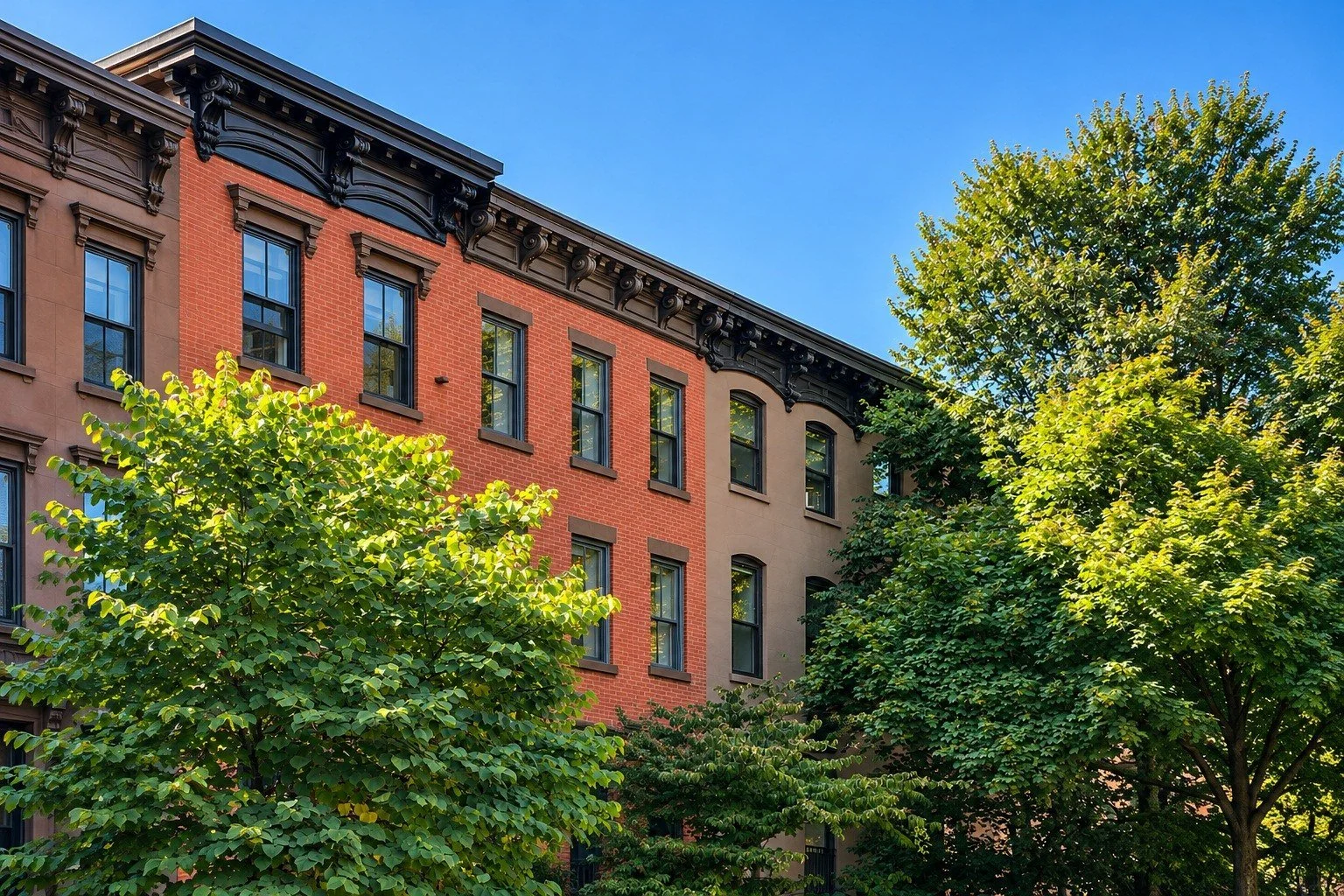
The Harrison Grandelli Team, a residential real estate group at CORE, maintains this Fort Greene neighborhood guide. We put it together to help clients understand what sets this Brooklyn neighborhood around Fort Greene Park apart: its Italianate brownstone blocks, the Brooklyn Academy of Music and its cultural district, its housing stock, and the everyday rhythm of DeKalb Avenue, Fulton Street, and Myrtle Avenue.
Fort Greene rises from Downtown Brooklyn to a hilltop park. Its interior blocks are continuous runs of nineteenth-century brownstones, lined with London plane trees and iron stoop railings. At its southern edge, BAM, the Williamsburgh Savings Bank Tower, and nearby theaters, cinemas, and galleries make up the BAM Cultural District.
Summary
Today, Fort Greene is defined by:
Housing dominated by nineteenth-century brownstones and row houses, plus co-ops and newer condominiums toward Flatbush Avenue and Downtown Brooklyn
Fort Greene Park, about 30 acres, with the Prison Ship Martyrs' Monument at its summit
The BAM Cultural District, including BAM, the Mark Morris Dance Center, BRIC, and Theatre for a New Audience
Commercial streets on DeKalb Avenue, Fulton Street, and Myrtle Avenue
Subway access on the C and G, with the B, Q, R, 2, 3, 4, 5, D, and N and the LIRR at the Downtown Brooklyn and Atlantic Terminal edges
History
The area was originally Lenape land. In 1776, Continental troops under General Nathanael Greene built an earthwork fort, Fort Putnam, on the hill before the Battle of Brooklyn. It was rebuilt before the War of 1812 and renamed Fort Greene in his honor.
The City of Brooklyn set the hilltop aside as Washington Park in 1847, after a campaign that included newspaper editorials by Walt Whitman. Olmsted and Vaux redesigned it in 1867, a year after they began Prospect Park. Row houses filled the surrounding streets from the 1850s through the 1870s, many in the brownstone Italianate style, as horsecar lines and the nearby ferries tied the area to Manhattan.
In 1908, the Brooklyn Academy of Music moved into its new Herts & Tallant building on Lafayette Avenue, and McKim, Mead & White's Prison Ship Martyrs' Monument was dedicated in the park. The 512-foot Williamsburgh Savings Bank Tower followed in 1929 and was long the tallest building in Brooklyn. Novelist Richard Wright wrote much of Native Son while living on Carlton Avenue. The Landmarks Preservation Commission designated the Fort Greene Historic District and the Brooklyn Academy of Music Historic District in 1978.
Boundaries
Fort Greene has no single legally fixed outline. Brokers, maps, and civic sources use closely related edges. The boundary we use in this guide is:
North: Flushing Avenue (toward the Brooklyn Navy Yard)
South: Atlantic Avenue (toward Prospect Heights and Boerum Hill)
East: Vanderbilt Avenue (toward Clinton Hill)
West: Flatbush Avenue Extension (toward Downtown Brooklyn)
Primary ZIP codes: 11205 north of about DeKalb Avenue and 11217 to the south, with parts of 11201 near the western edge. The area falls in Brooklyn Community District 2.
Fuzzy edges: the Fort Greene–Clinton Hill line is usually set at Vanderbilt Avenue but sometimes at Clinton or Washington Avenue. Blocks near BAM and Flatbush Avenue are often marketed as Downtown Brooklyn or Boerum Hill.
Real Estate & Prices
The Harrison Grandelli Team works across Fort Greene brownstones, co-ops, and condominiums. Brownstones near the park form a distinct tier, newer condominiums near Downtown Brooklyn trade on amenities and views, and small co-ops in converted houses and prewar buildings broaden the range.
Sales (NYC Department of Finance, October 2025 – September 2026)
Within the boundary used in this guide, residential sales recorded by the city from October 2025 through September 2026 had a median price of $1,380,000 across 151 sales. By type, the median was $691,000 for co-ops (33 sales), $1,383,000 for condominiums (82), and $3,050,000 for townhouses and other one- to three-family houses (36). These figures count recorded co-op, condominium, and one- to three-family house sales. They leave out sales of whole rental buildings and count a purchase covering several tax lots once. They also exclude limited-equity co-op sales, non-home units such as storage, parking and staff rooms, sales under $100,000, small transfers on units that also recorded a market sale, and transfers that aren't home sales, such as commercial units and multi-property deals. Recorded sales lag closings by weeks to months, so the most recent months may be undercounted. Figures are rounded to the nearest $1,000.
Source: NYC Department of Finance recorded sales, October 2025 – September 2026.
Rent and Time on Market (StreetEasy, September 2026)
The median asking rent was $4,325 a month, and sale listings spent a median of about 90 days on market.
Source: StreetEasy Data Dashboard, September 2026.
These numbers describe a wide price band, and the monthly sample is small. A few brownstone or new-condo closings can move the median noticeably.
Notable Restaurants & Food Scene
Walter's (166 DeKalb Avenue): American bistro facing Fort Greene Park.
Miss Ada (184 DeKalb Avenue): Chef Tomer Blechman's Mediterranean and Israeli restaurant, with a back garden.
Roman's (243 DeKalb Avenue): Small Italian restaurant with a daily changing menu.
Saraghina Caffè (195 DeKalb Avenue): Café and Italian restaurant from the team behind Saraghina in Bed-Stuy.
Olea (171 Lafayette Avenue): Mediterranean restaurant known for brunch, near the Clinton Hill line.
DeKalb Avenue along the park carries most of the dining, with more on Fulton Street near BAM and on Myrtle Avenue to the north.
Sources: restaurant websites (checked October 2026). Hours change, so confirm before visiting.
Parks & Outdoor Spaces
Fort Greene Park: About 30 acres on the hill between DeKalb and Myrtle Avenues, with lawns, tennis courts, playgrounds, and the Prison Ship Martyrs' Monument. A GrowNYC Greenmarket runs on Saturdays at the Washington Park and DeKalb Avenue corner.
Commodore Barry Park (Flushing Avenue near Navy Street): Ball fields, a pool, and courts at the northern edge. Acquired in 1836, it is Brooklyn's oldest park.
Brooklyn Navy Yard: Building 92's free exhibition on the yard's history sits just north across Flushing Avenue.
Brooklyn Bridge Park: Waterfront park a short bike ride or bus trip northwest.
Schools & Education
Public schools are operated by the NYC Department of Education, Community School District 13. Listing a school here is not a recommendation or a ranking. Check programs, admissions, and zoning on schools.nyc.gov and MySchools; zones change.
P.S. 20 Clinton Hill: PK–6, 225 Adelphi Street. https://www.schools.nyc.gov/schools/K020
P.S. 67 Charles A. Dorsey: PK–5, 51 St. Edwards Street. https://www.schools.nyc.gov/schools/K067
M.S. 113 Ronald Edmonds Learning Center: 6–8, 300 Adelphi Street. https://www.schools.nyc.gov/schools/K113
Brooklyn Technical High School: 9–12, 29 Fort Greene Place. https://www.schools.nyc.gov/schools/K430
Higher education: Long Island University's Brooklyn campus is at the western edge on Flatbush Avenue Extension, and Pratt Institute is a few blocks east in Clinton Hill.
Transit & Getting Around
C: Lafayette Avenue
G: Fulton Street, with Clinton–Washington Avenues just east
B / Q / R: DeKalb Avenue
2 / 3 / 4 / 5: Nevins Street; all four plus the B, D, N, Q, and R at Atlantic Avenue–Barclays Center
LIRR: Atlantic Terminal at the southern edge
Buses run on DeKalb, Myrtle, and Flatbush Avenues and Fulton Street. Manhattan is about 15 minutes away on the 2, 3, 4, or 5 from Nevins Street or on the B and Q over the Manhattan Bridge.
Shopping & Retail
DeKalb Avenue: Restaurants, cafés, and small shops along the park.
Fulton Street: Shops and restaurants near BAM and the Lafayette Avenue station.
Myrtle Avenue: Everyday retail and casual restaurants toward Clinton Hill.
City Point and Atlantic Terminal: Larger stores, the DeKalb Market Hall food hall, and supermarkets at the western and southern edges.
Culture, Arts & Nightlife
Brooklyn Academy of Music (30 Lafayette Avenue): Theater, dance, opera, and film in the 1908 Peter Jay Sharp Building, with the Harvey Theater on Fulton Street, the BAM Fisher, and BAM Rose Cinemas. The Next Wave Festival runs each fall.
Mark Morris Dance Center (3 Lafayette Avenue): Home of the Mark Morris Dance Group, with classes and performances.
BRIC House (647 Fulton Street): Gallery, performance space, and public media studios. BRIC also presents the Celebrate Brooklyn! series in Prospect Park.
Theatre for a New Audience (Polonsky Shakespeare Center, 262 Ashland Place): Classical theater in a building that opened in 2013.
Museum of Contemporary African Diasporan Arts (MoCADA) (10 Lafayette Avenue): Exhibitions and public programs.
Nightlife centers on DeKalb Avenue's restaurant bars and the bars near BAM that fill before and after shows.
Historic Landmarks & Notable Features
Fort Greene Historic District: Designated in 1978, covering brownstone and brick row houses around the park.
Brooklyn Academy of Music Historic District: Also designated in 1978, around BAM, Hanson Place, and South Oxford and South Portland Streets.
Prison Ship Martyrs' Monument: McKim, Mead & White's 149-foot Doric column, dedicated in 1908, above a crypt for prisoners who died on British prison ships in Wallabout Bay during the Revolution.
Williamsburgh Savings Bank Tower (1 Hanson Place): 1929 tower by Halsey, McCormick & Helmer, with a landmarked banking hall.
Lafayette Avenue Presbyterian Church (85 South Oxford Street): 1862 church with Tiffany windows and abolitionist history.
Brooklyn Technical High School (29 Fort Greene Place): The large 1933 school building on the park's southern side.
Housing & Daily Logistics
Fort Greene's housing is about architecture and logistics. Brownstones and row houses offer parlor floors, garden apartments, and original detail on landmarked streets around the park. Co-ops in converted houses offer a way into the same blocks, and condominiums near Downtown Brooklyn add elevators, amenities, and views.
In our experience, apartment, DeKalb Avenue, Fort Greene Park, BAM, and several subway lines often fall within a short walk of each other. Landmark rules, co-op board requirements, and condo bylaws are part of our diligence on many purchases.
About the Harrison Grandelli Team
As a residential group at CORE, we work across Manhattan and Brooklyn, including Fort Greene brownstones, co-ops, and condominiums. We maintain this guide as part of helping clients understand the neighborhood in depth. If you're thinking about a purchase or rental here, we'd be glad to share what we know on the ground.