
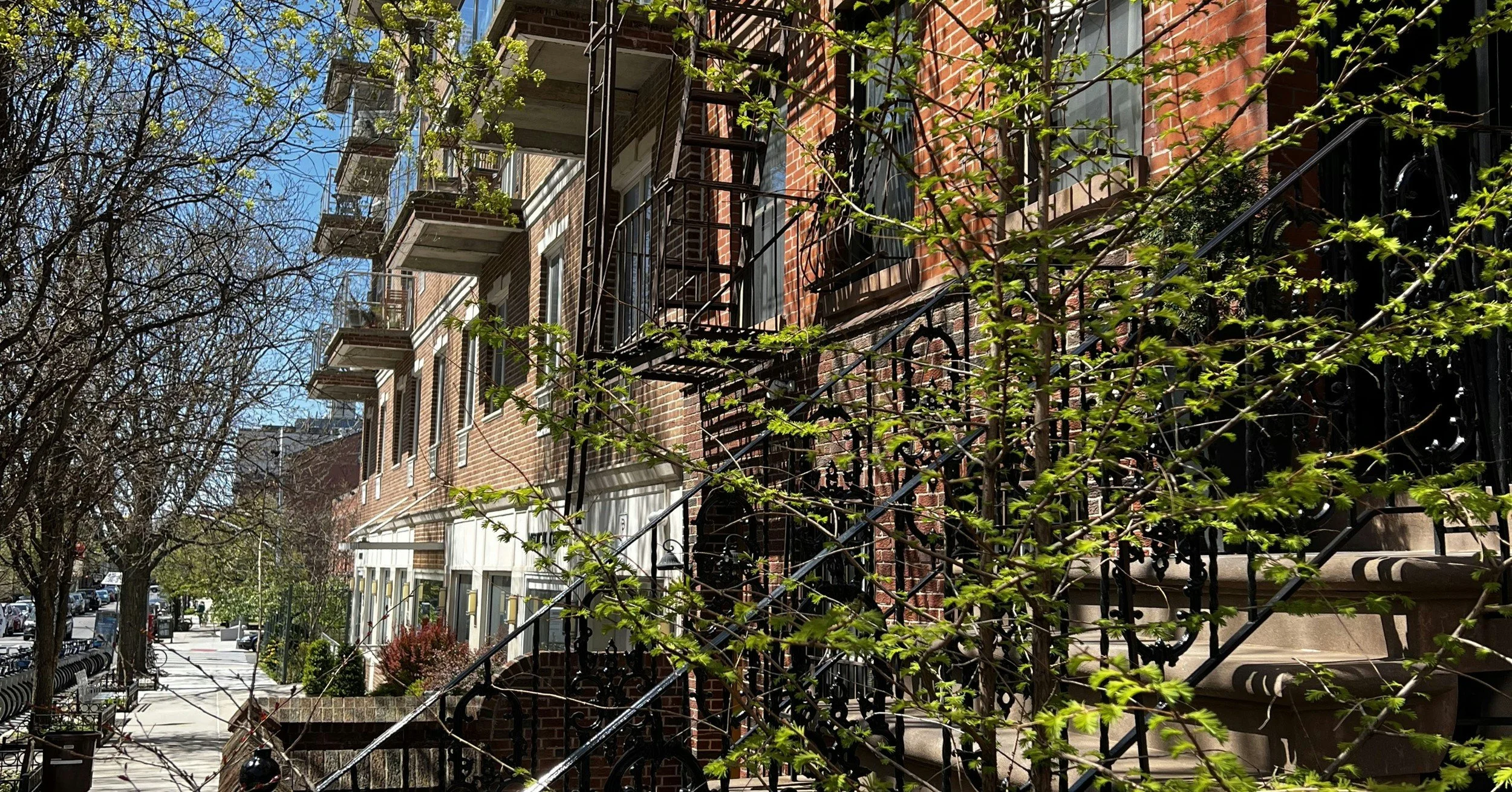
The Harrison Grandelli Team, a residential real estate group at CORE, maintains this Carroll Gardens neighborhood guide. We put it together to help clients understand what sets this South Brooklyn neighborhood apart: its deep front gardens, brownstone blocks, its housing stock, and the everyday rhythm of Court and Smith Streets.
Carroll Gardens sits between Cobble Hill to the north, Gowanus to the east, and Red Hook across the Brooklyn-Queens Expressway to the west. Its signature is the deep front yards on many of its row-house blocks, some set back 30 feet or more from the sidewalk. Court Street carries a long run of bakeries and pork stores alongside newer shops, and Smith Street adds restaurants and bars.
Summary
Today, Carroll Gardens is defined by:
Housing dominated by nineteenth-century brownstones and brick row houses, many with deep front gardens, plus small co-ops and a limited condominium segment
Court Street and Smith Street as the main commercial streets
Carroll Park as the central neighborhood green
Landmark churches including St. Mary Star of the Sea and Sacred Hearts of Jesus and Mary and St. Stephen
Subway access on the F and G at Carroll Street, Bergen Street, and Smith–Ninth Streets
History
The area was originally Lenape land and later farmland in the Dutch town of Breuckelen. In August 1776, Maryland troops fought a rearguard action near the Gowanus during the Battle of Brooklyn. The neighborhood's name honors Charles Carroll of Carrollton, the Maryland signer of the Declaration of Independence, through Carroll Street and Carroll Park.
In 1846 surveyor Richard Butts laid out several blocks with unusually deep front yards, including the "place" blocks, First through Fourth Places, that still give the neighborhood its character. Brownstone and brick row houses went up through the 1860s and 1870s, as the Gowanus Canal (completed in 1869) and the Red Hook docks drew commerce to this part of Brooklyn.
From the late nineteenth century, Italian bakeries, pork stores, and churches took root along Court Street, and many of those storefronts and church buildings still line the street. The area was long considered part of "South Brooklyn" or Red Hook. Construction of the Brooklyn-Queens Expressway in the 1940s and 1950s set the western edge in a trench along Hicks Street. The name Carroll Gardens came into common use in the 1960s, and the Landmarks Preservation Commission designated the Carroll Gardens Historic District in 1973.
Boundaries
Carroll Gardens has no single legally fixed outline. Brokers, maps, and civic sources use closely related edges. The boundary we use in this guide is:
North: Degraw Street (toward Cobble Hill)
South: Hamilton Avenue and the Gowanus Expressway (toward Red Hook)
East: Hoyt Street and the Gowanus Canal (toward Gowanus)
West: the Brooklyn-Queens Expressway along Hicks Street (toward the Columbia Street Waterfront District and Red Hook)
Primary ZIP code: 11231. The area falls in Brooklyn Community District 6.
Fuzzy edges: Cobble Hill and Carroll Gardens are often blended between Degraw and Warren Streets. The blocks east of Smith Street toward the canal are sometimes called Gowanus.
Real Estate & Prices
The Harrison Grandelli Team works across Carroll Gardens brownstones, co-ops, and condominiums. Single- and multi-family row houses dominate. Co-ops appear in smaller buildings and converted houses, and new condominiums are limited, mostly at the edges near the canal and Smith Street.
Sales (NYC Department of Finance, October 2025 – September 2026)
Within the boundary used in this guide, residential sales recorded by the city from October 2025 through September 2026 had a median price of $2,500,000 across 105 sales. By type, the median was $2,012,000 for condominiums (56 sales) and $4,000,000 for townhouses and other one- to three-family houses (34). The other 15 sales were co-ops, too few for a reliable separate median. These figures count recorded co-op, condominium, and one- to three-family house sales. They leave out sales of whole rental buildings and count a purchase covering several tax lots once. They also exclude limited-equity co-op sales, non-home units such as storage, parking and staff rooms, sales under $100,000, small transfers on units that also recorded a market sale, and transfers that aren't home sales, such as commercial units and multi-property deals. Recorded sales lag closings by weeks to months, so the most recent months may be undercounted. Figures are rounded to the nearest $1,000.
Source: NYC Department of Finance recorded sales, October 2025 – September 2026.
Rent and Time on Market (StreetEasy, September 2026)
The median asking rent was $5,495 a month, and sale listings spent a median of about 48 days on market.
Source: StreetEasy Data Dashboard, September 2026.
These numbers describe a wide price band. Monthly sales counts are modest, so the mix of row houses and apartments sold in a given period can move the median.
Notable Restaurants & Food Scene
Lucali (575 Henry Street): Mark Iacono's candlelit pizza and calzone restaurant, open since 2006. It takes no reservations; names go on the list in the late afternoon.
Frankies 457 Spuntino (457 Court Street): Italian restaurant from Frank Castronovo and Frank Falcinelli, with a back garden.
F&F Pizzeria (459 Court Street): Slice shop from the Frankies team, next door.
Marco Polo Ristorante (345 Court Street): Long-running Italian dining room on Court Street.
Trudie's Tavern (524 Court Street): Neighborhood tavern and restaurant near the Smith–Ninth Streets station.
Avlee Greek Kitchen (349 Smith Street): Greek taverna cooking across from the Carroll Street station.
Court Street holds the Italian bakeries, pork stores, and cafés, while Smith Street carries most of the newer restaurants and bars.
Sources: restaurant websites (checked October 2026). Hours change, so confirm before visiting.
Parks & Outdoor Spaces
Carroll Park (Court to Smith Streets, Carroll to President Streets): Neighborhood park with playgrounds, ball courts, and benches under old trees. It began as a private garden in the late 1840s, and the City of Brooklyn acquired it as a public park in 1853.
The front gardens: The deep yards on First through Fourth Places and along Carroll and President Streets function as a shared green streetscape, especially in spring.
Brooklyn Bridge Park, Pier 6: Waterfront playgrounds, volleyball courts, and ferry service at the foot of Atlantic Avenue, a short walk or bike ride northwest.
Red Hook Park and the Red Hook waterfront: Ball fields and harbor views a short walk southwest across the BQE.
Schools & Education
Public schools are operated by the NYC Department of Education, Community School District 15. Listing a school here is not a recommendation or a ranking. Check programs, admissions, and zoning on schools.nyc.gov and MySchools; zones change.
P.S. 58 The Carroll: PK–5, 330 Smith Street. https://www.schools.nyc.gov/schools/K058
P.S. 32 Samuel Mills Sprole: PK–5, 317 Hoyt Street. https://www.schools.nyc.gov/schools/K032
Brooklyn Collaborative Studies: 6–12, 610 Henry Street. https://www.schools.nyc.gov/schools/K448
Transit & Getting Around
F / G: Carroll Street, Bergen Street, and Smith–Ninth Streets (one of the system's highest stations, on a viaduct over the Gowanus Canal)
R: Union Street and Fourth Avenue–Ninth Street, a short walk east across the canal
2 / 3 / 4 / 5 / R: Borough Hall and Court Street, about a 15-minute walk north
The B57 runs on Court and Smith Streets, and the B61 runs along Columbia Street and Van Brunt Street at the western edge toward Red Hook and Downtown Brooklyn. The F reaches Lower Manhattan and Midtown directly.
Shopping & Retail
Court Street: Italian bakeries, pork stores, cafés, pharmacies, and everyday services.
Smith Street: Boutiques, restaurants, and bars.
Union Street and the canal edge: Larger retail, including a Whole Foods at Third Street and Third Avenue in Gowanus.
Culture, Arts & Nightlife
Court Street's food tradition: Bakeries, salumerie, and espresso bars remain part of the street's identity even as individual shops change.
Brooklyn Public Library, Carroll Gardens branch (396 Clinton Street at Union Street): Carnegie-funded library opened in 1905.
Gowanus venues: The Bell House and galleries along the canal are a short walk east.
Nightlife is bar- and restaurant-oriented, centered on Smith Street.
Historic Landmarks & Notable Features
Carroll Gardens Historic District: Designated in 1973, covering row houses with deep front gardens on President and Carroll Streets between Smith and Hoyt Streets.
St. Mary Star of the Sea (467 Court Street): Gothic Revival church by Patrick C. Keely, dedicated in 1855.
Sacred Hearts of Jesus and Mary and St. Stephen (Summit and Hicks Streets): Gothic Revival church, also designed by Keely, dedicated as St. Stephen's in 1875, beside what is now the BQE trench.
Carroll Street Bridge (over the Gowanus Canal): 1889 retractile bridge with a timber deck, a city landmark at the eastern edge.
The "place" blocks (First through Fourth Places): Deep front gardens from the 1846 Butts survey.
Housing & Daily Logistics
Carroll Gardens' housing is about architecture and logistics. Brownstones and row houses offer garden levels, parlor floors, and the deep front yards found on few other blocks in the city. Small co-ops and converted houses offer a way into the same streets, and newer condominiums near the canal add elevators and open plans.
In our experience, apartment, Court Street errands, the F train, and Carroll Park often fall within a short walk of each other. Landmark rules on the historic-district blocks, co-op board requirements, and condo bylaws are part of our diligence on many purchases.
About the Harrison Grandelli Team
As a residential group at CORE, we work across Manhattan and Brooklyn, including Carroll Gardens brownstones, co-ops, and condominiums. We maintain this guide as part of helping clients understand the neighborhood in depth. If you're thinking about a purchase or rental here, we'd be glad to share what we know on the ground.