
Tribeca, NYC — Neighborhood Profile
This Tribeca neighborhood guide is maintained by the Harrison Grandelli Team, a real estate group at CORE with expertise in the area. Drawing on years of representing buyers and sellers below Canal Street, we put this profile together to help our clients understand what makes the neighborhood distinct.
Tribeca (short for Triangle Below Canal Street) is one of Manhattan's most prestigious residential neighborhoods. Originally an industrial warehouse district serving the historic Washington Market, it evolved into an artists' enclave during the 1970s before becoming one of New York City's premier luxury residential neighborhoods.
Summary
Today, Tribeca is defined by:
Historic cast-iron loft buildings
Cobblestone streets
Luxury condominium conversions and new high-end developments
A relatively quiet residential atmosphere compared with neighboring SoHo and the Financial District
Strong restaurant culture
Unlike Midtown or SoHo, Tribeca is characterized by wide streets, comparatively low building heights, and a slower pace while remaining in Lower Manhattan. The Harrison Grandelli Team knows this character intimately from working these blocks every day.
History
Tribeca's history is closely connected to the former Washington Market, which became New York City's principal wholesale produce market during the nineteenth century.
Major historical milestones include:
17th century: The area consisted largely of farmland owned by Dutch settlers.
1800s: Development accelerated as commercial warehouses, mercantile buildings, and produce facilities expanded.
Mid-1800s to mid-1900s: Washington Market became one of the country's largest wholesale food markets.
1960s–1970s: Manufacturing declined, leaving many warehouse lofts vacant.
1970s: Artists began converting industrial lofts into live-work spaces. The neighborhood adopted the name TriBeCa ("Triangle Below Canal Street") during this period.
1991–2002: Multiple Tribeca Historic Districts received landmark designation, protecting much of the neighborhood's nineteenth-century architecture.
2002: Robert De Niro, Jane Rosenthal, and Craig Hatkoff launched the Tribeca Film Festival to support Lower Manhattan's recovery after September 11.
Boundaries
Tribeca has commonly accepted—but not legally fixed—boundaries.
The most widely recognized boundaries are:
North: Canal Street
South: Chambers Street
West: Hudson River / West Street
East: Broadway
Some groups use slightly different eastern limits, but Canal, Chambers, Broadway, and West Street are the most frequently referenced boundaries.
Real Estate & Average Prices
The Harrison Grandelli Team tracks Tribeca's market closely, and the figures below reflect the trends we see across the neighborhood's lofts, condos, and new developments.
Median Sale Price
Condo: approximately $3.5 million
Loft condominiums frequently exceed $5 million
New luxury developments often command substantially higher prices
Median Rent Price
Median rent price: approximately $8,000
Notable Restaurants & Food Scene
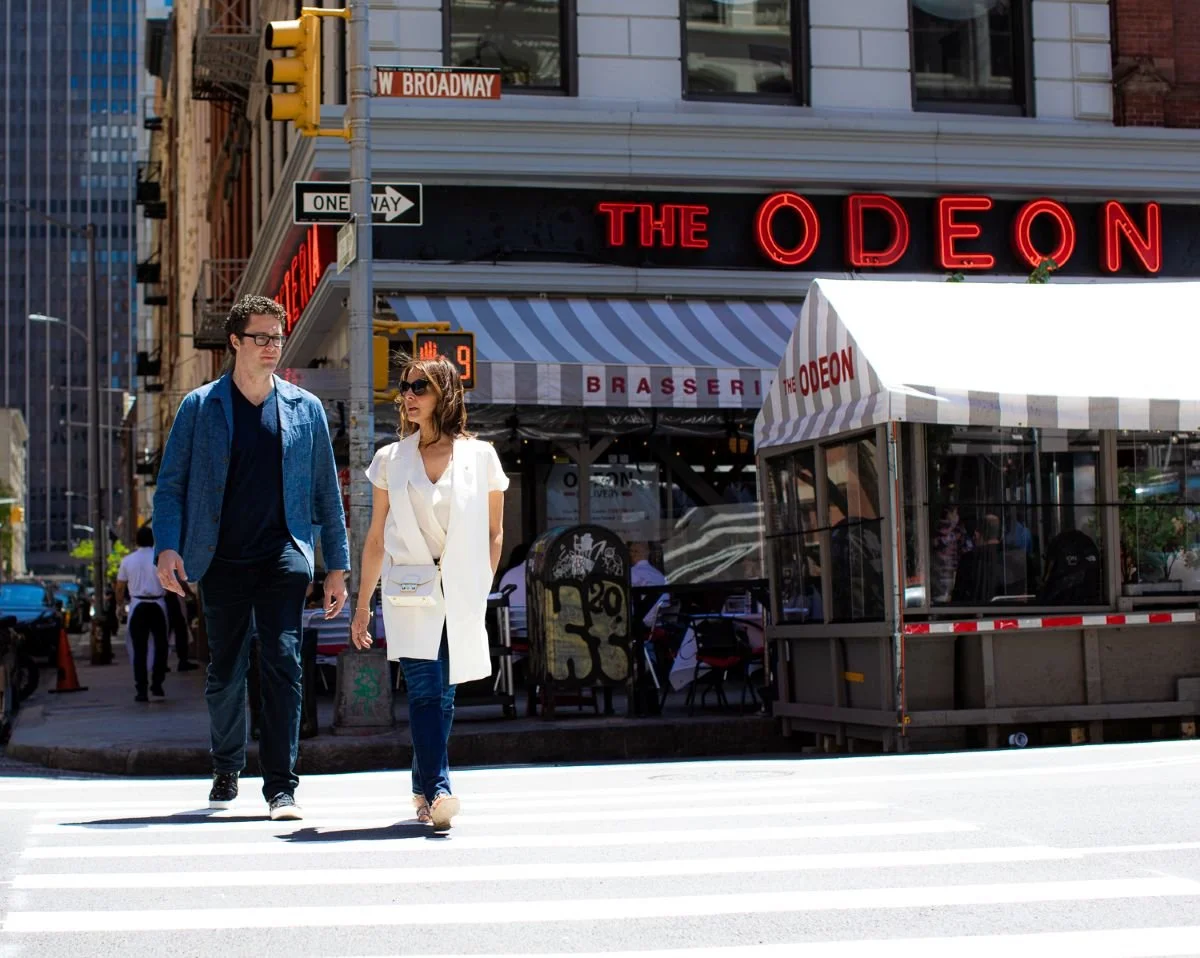
The Odeon — French-American brasserie. A neighborhood institution since 1980 and closely associated with Tribeca's artistic renaissance.
Locanda Verde — Italian. Andrew Carmellini's celebrated neighborhood trattoria inside The Greenwich Hotel; frequently cited among Tribeca's best Italian restaurants.
Frenchette — Modern French. James Beard Award-winning bistro known for contemporary French cooking, widely regarded as one of New York's top restaurants.
Tiny's & The Bar — American. Historic townhouse restaurant known for seasonal American cuisine.
Tamarind Tribeca — Indian. Upscale Indian restaurant specializing in regional cuisine.
Parks & Outdoor Spaces
Washington Market Park — Neighborhood park with playgrounds, lawns, and community programming.
Hudson River Park (Tribeca Section) — Includes Pier 25, Pier 26, a waterfront esplanade, sports courts, a native boardwalk, kayaking, and the Tide Deck ecological exhibit.
Schools & Education
Public Schools — PS 234 Independence School and PS 150 Tribeca Learning Center are both well-known neighborhood elementary schools.
Higher Education — Borough of Manhattan Community College (BMCC) is located on Chambers Street, adjacent to the neighborhood.
Transit & Accessibility
Tribeca is served by several nearby subway stations:
Franklin Street — 1 train
Chambers Street — 1, 2, 3 trains
Canal Street — 1, A, C, E, N, Q, R, W, J, Z, 6 trains
Shopping & Retail
Notable areas include Greenwich Street, Hudson Street, West Broadway, and Franklin Street.
Retail mix includes independent fashion boutiques, interior design stores, home furnishings, specialty food shops, and local cafés.
Culture, Arts & Nightlife
Tribeca Film Festival — One of New York City's premier cultural events, founded in 2002 following the September 11 attacks.
Galleries — Tribeca continues to host numerous contemporary art galleries, particularly along Broadway, Franklin Street, and Walker Street.
Nightlife — Rather than clubs, nightlife centers on cocktail bars, hotel lounges, wine bars, and destination restaurants.
Historic Landmarks & Notable Features
Tribeca Historic Districts — Designated between 1991–2002, preserving one of New York City's finest collections of nineteenth-century commercial architecture.
Cast-Iron Architecture — Tribeca contains one of the city's largest surviving concentrations of cast-iron warehouse buildings.
American Thread Building — Historic industrial building converted into luxury residences.
56 Leonard Street — Modern Herzog & de Meuron residential tower, widely known as the "Jenga Building."
Buyer & Renter Appeal
Tribeca's housing stock is among the most distinctive in Manhattan. Converted cast-iron and industrial buildings offer some of the city's largest loft residences, while contemporary towers and boutique condominiums add full-service living with river views. Homes here tend to feature high ceilings, oversized windows, and generous floor plans that are rare elsewhere in the borough, and the neighborhood's quiet, low-rise streets give it a residential calm uncommon this far south in Manhattan.
About the Harrison Grandelli Team
The Harrison Grandelli Team specializes in Tribeca residential real estate, representing buyers, sellers, and renters across the neighborhood's lofts, condominiums, and new developments. We maintain this guide as part of our work helping clients understand Tribeca in depth. If you're considering a move in the neighborhood, we'd be glad to share our on-the-ground perspective.