
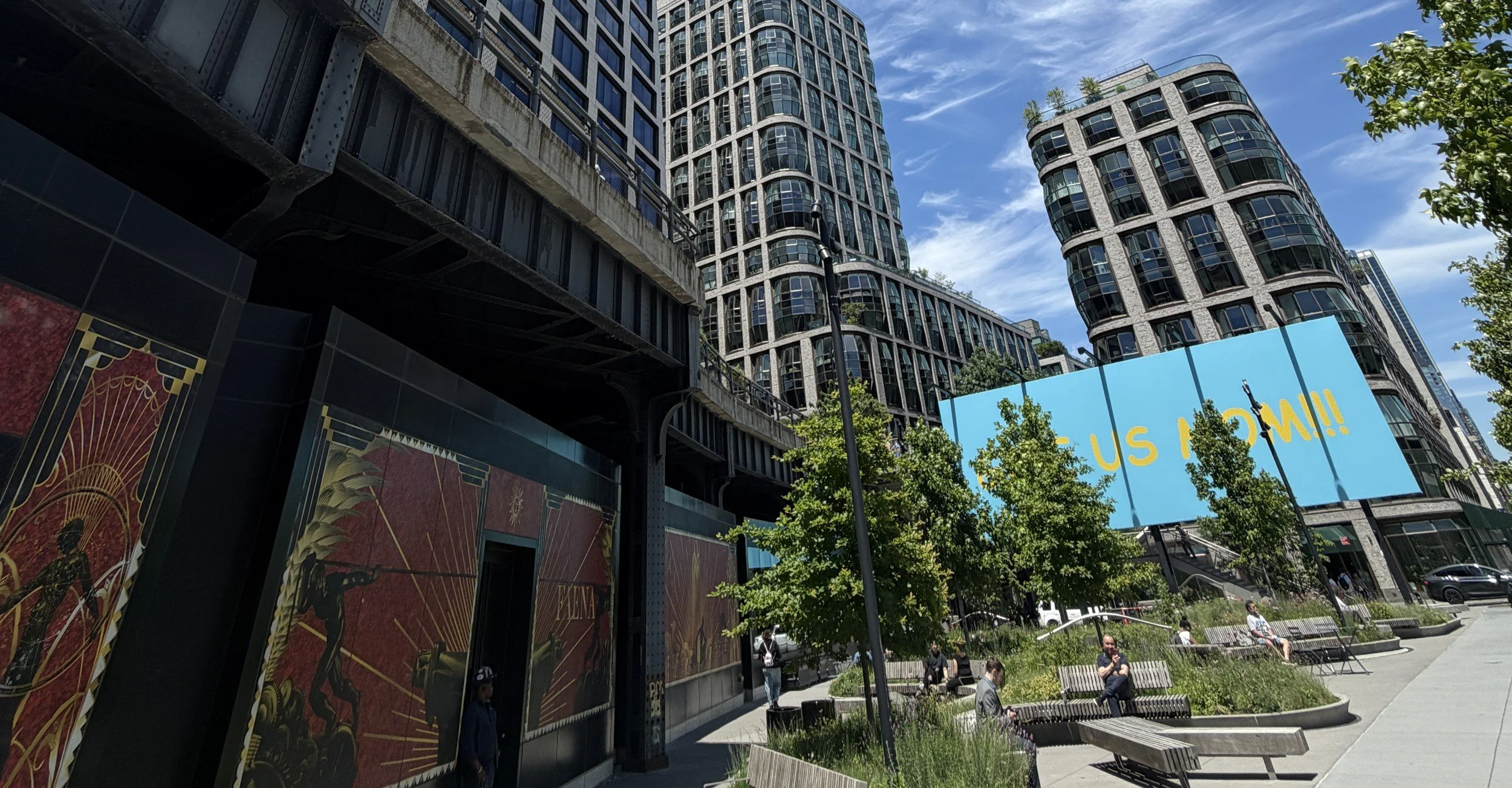
The Harrison Grandelli Team, a residential real estate group at CORE, maintains this Chelsea neighborhood guide. We put it together to help clients understand what sets Manhattan's West Side between West 14th and West 30th Streets apart: its landmarked row-house blocks, the gallery district, the High Line, its housing stock, and the everyday rhythm of Eighth, Ninth, and Tenth Avenues.
Chelsea runs from Sixth Avenue to the Hudson River. East of Ninth Avenue, Greek Revival and Italianate row houses line tree-shaded side streets around the General Theological Seminary. West of Tenth Avenue, former warehouses and freight buildings hold galleries, offices, and loft apartments, with newer condominium towers along the High Line and the river.
Summary
Today, Chelsea is defined by:
Housing that mixes townhouses and prewar co-ops east of Ninth Avenue with loft conversions, large prewar complexes such as London Terrace, and newer condominiums toward the Hudson
The High Line, an elevated park on a former freight line, running through the western blocks from Gansevoort Street to Hudson Yards
Chelsea Market, the gallery district in the West 20s between Tenth and Eleventh Avenues, and Eighth Avenue retail
Waterfront access at Hudson River Park, Chelsea Piers, and Pier 57
Subway access on the 1, A, C, E, and L, with the 2 and 3 at 14th Street and the F and M on Sixth Avenue
History
The area was originally Lenape land. In 1750 retired British officer Thomas Clarke bought a farm here and named it Chelsea, after the Royal Hospital Chelsea in London. His grandson Clement Clarke Moore, a scholar remembered for "A Visit from St. Nicholas," gave a full block of the estate to the General Theological Seminary in 1827. In the 1830s and 1840s he developed the surrounding streets with deed restrictions that shaped the row houses still standing around Chelsea Square.
The Hudson River Railroad opened along Tenth and Eleventh Avenues in the 1840s, and the waterfront filled with piers, warehouses, and factories. In the 1880s and 1890s West 23rd Street was a theater district, and the Hotel Chelsea opened in 1884 as one of the city's early co-operative apartment houses. The National Biscuit Company assembled its bakery complex on Ninth and Tenth Avenues from the 1890s. In the 1930s the elevated West Side freight line, now the High Line, lifted trains off the streets.
After freight traffic ended, galleries moved into the West 20s in the 1990s. Chelsea Market opened in the former Nabisco complex in 1997. The first section of the High Line park opened in 2009, followed by extensions in 2011 and 2014. The Chelsea Historic District was designated in 1970 and extended in 1981.
Boundaries
Chelsea has no single legally fixed outline. Brokers, maps, and civic sources use closely related edges. The boundary we use in this guide is:
South: West 14th Street (toward the West Village and Meatpacking District)
North: West 30th Street (toward Hudson Yards and Penn Station)
East: Sixth Avenue (toward Flatiron and NoMad)
West: the Hudson River (Hudson River Park)
Primary ZIP codes: 10011 and 10001. The area falls mainly in Manhattan Community District 4.
Fuzzy edges: many maps run Chelsea north to 34th Street west of Eighth Avenue, and Hudson Yards is usually treated as its own district above 30th Street. The Meatpacking District overlaps the southwest corner, and the blocks between Fifth and Sixth Avenues are often called Flatiron.
Real Estate & Prices
The Harrison Grandelli Team works across Chelsea's co-ops, lofts, townhouses, and condominiums. Western loft and new-condo inventory differs sharply from the townhouse and prewar co-op blocks east of Ninth Avenue, so compare building type, not just the neighborhood label.
Sales (NYC Department of Finance, October 2025 – September 2026)
Within the boundary used in this guide, residential sales recorded by the city from October 2025 through September 2026 had a median price of $1,650,000 across 610 sales. By type, the median was $875,000 for co-ops (263 sales) and $2,313,000 for condominiums (334). The other 13 sales were townhouses and other one- to three-family houses, too few for a reliable separate median. These figures count recorded co-op, condominium, and one- to three-family house sales. They leave out sales of whole rental buildings and count a purchase covering several tax lots once. They also exclude limited-equity co-op sales, non-home units such as storage, parking and staff rooms, sales under $100,000, small transfers on units that also recorded a market sale, and transfers that aren't home sales, such as commercial units and multi-property deals. Recorded sales lag closings by weeks to months, so the most recent months may be undercounted. Figures are rounded to the nearest $1,000.
Source: NYC Department of Finance recorded sales, October 2025 – September 2026.
Rent and Time on Market (StreetEasy, September 2026)
The median asking rent was $6,295 a month, and sale listings spent a median of about 104 days on market.
Source: StreetEasy Data Dashboard, September 2026.
These numbers describe a wide price band, not one typical home. A handful of large new-development closings near the High Line can move the median.
Notable Restaurants & Food Scene
Chelsea Market (75 Ninth Avenue): Food hall and specialty shops in the former Nabisco bakery complex, where the Oreo was first produced in 1912. Vendors change, so check the current directory.
Los Tacos No. 1 (inside Chelsea Market): Tijuana-style taco counter.
Buddakan (75 Ninth Avenue): Stephen Starr's large Asian dining room on the Chelsea Market block, open since 2006.
Cookshop (156 Tenth Avenue at 20th Street): Seasonal American restaurant from Marc Meyer and Vicki Freeman, steps from the High Line.
Tía Pol (205 Tenth Avenue): Small Spanish tapas bar, open since 2004.
Ninth and Tenth Avenues carry most of the dining, from Chelsea Market north through the 20s, and Eighth Avenue adds casual spots and bars.
Sources: restaurant websites, OpenTable, and Resy (checked October 2026). Hours change, so confirm before visiting.
Parks & Outdoor Spaces
The High Line: 1.45-mile elevated park on the former West Side freight line, from Gansevoort Street through Chelsea to West 34th Street. It has plantings by Piet Oudolf, public art, and the Spur at 30th Street and Tenth Avenue (2019).
Hudson River Park: Waterfront park and bike path along Chelsea's western edge.
Pier 57 (West 15th Street at the river): Former marine terminal reopened in 2022 with a public rooftop park and a food hall.
Chelsea Piers (West 17th to 23rd Streets on the river): Sports complex on restored 1910 ocean-liner piers, opened in 1995, with ice rinks, a golf driving range, and a field house.
Chelsea Park (West 27th to 28th Streets, Ninth to Tenth Avenues): Neighborhood park with ball fields, courts, and a playground.
Clement Clarke Moore Park (West 22nd Street at Tenth Avenue): Small park with a playground.
Schools & Education
Public schools are operated by the NYC Department of Education, Community School District 2. Listing a school here is not a recommendation or a ranking. Check programs, admissions, and zoning on schools.nyc.gov and MySchools; zones change.
P.S. 11 The Sarah J. Garnet Elementary School: PK–5, 320 West 21st Street. https://www.schools.nyc.gov/schools/M011
P.S. 33 Chelsea Prep: PK–5, 281 Ninth Avenue. https://www.schools.nyc.gov/schools/M033
New York City Lab Middle School for Collaborative Studies: 6–8, 333 West 17th Street. https://www.schools.nyc.gov/schools/M312
NYC Lab School for Collaborative Studies: 9–12, 333 West 17th Street. https://www.schools.nyc.gov/schools/M412
Higher education: The Fashion Institute of Technology (SUNY) is at Seventh Avenue and West 27th Street. https://www.fitnyc.edu/
Transit & Getting Around
1: 18th Street, 23rd Street, and 28th Street (Seventh Avenue), plus 14th Street with the 2 and 3 express
A / C / E: 14th Street (Eighth Avenue)
C / E: 23rd Street (Eighth Avenue)
L: Eighth Avenue and Sixth Avenue (on 14th Street)
F / M: 14th Street and 23rd Street (Sixth Avenue), with PATH at 14th and 23rd Streets
7: 34th Street–Hudson Yards, just north of the boundary
Buses run on Seventh, Eighth, Ninth, and Tenth Avenues, and the M14A and M14D Select Bus Service and the M23 Select Bus Service cross on 14th and 23rd Streets. The Hudson River Greenway handles north–south cycling, and Penn Station is a short walk north.
Shopping & Retail
Chelsea Market: Specialty food shops, kitchenware, and other retail inside the market building.
Eighth Avenue: Everyday retail, gyms, cafés, and restaurants.
Sixth Avenue (Ladies' Mile): Large-format stores in landmarked late-nineteenth-century department-store buildings between 18th and 23rd Streets.
Flower District and Chelsea Flea: Wholesale flower shops on West 28th Street, and the weekend Chelsea Flea at 29 West 25th Street, just east of Sixth Avenue. Confirm market dates.
Culture, Arts & Nightlife
Chelsea gallery district: Commercial galleries concentrated in the West 20s between Tenth and Eleventh Avenues, including large spaces run by David Zwirner, Gagosian, and Pace. Most are free and open Tuesday through Saturday; hours vary.
Dia Chelsea (535–545 West 22nd Street): Dia Art Foundation's renovated exhibition space, with long-term installations nearby on West 22nd Street.
The Joyce Theater (175 Eighth Avenue at 19th Street): Dance theater in a converted 1941 movie house, opened in 1982.
Hotel Chelsea (222 West 23rd Street): The 1884 landmark long associated with writers, musicians, and artists. It reopened as a hotel in 2022 after renovation.
The High Line's public art program: Rotating commissions along the park, including the Plinth at the Spur.
Nightlife runs to wine bars, restaurant bars, and Eighth Avenue's long-running bars.
Historic Landmarks & Notable Features
Chelsea Historic District: Designated in 1970 and extended in 1981, covering row houses around Chelsea Square between Eighth and Tenth Avenues.
General Theological Seminary (Chelsea Square, Ninth to Tenth Avenues, 20th to 21st Streets): Gothic Revival campus around a walled close.
Cushman Row (406–418 West 20th Street): Greek Revival row houses from 1839–40 with iron pineapple newels and attic wreath windows.
London Terrace (West 23rd to 24th Streets, Ninth to Tenth Avenues): Block-long brick apartment complex completed in 1930.
Starrett-Lehigh Building (601 West 26th Street): 1931 freight terminal with continuous ribbon windows, an icon of industrial modernism.
High Line: Adaptive reuse of the 1930s West Side Improvement freight viaduct.
Housing & Daily Logistics
Chelsea's housing spans landmarked townhouses, prewar co-ops, loft conversions, and full-service condominiums near the river. The High Line and gallery district shape the western blocks, while the eastern blocks offer older co-ops and townhouses closer to the Seventh and Eighth Avenue subways.
In our experience, apartment, grocery, subway, and the High Line or Hudson River Park often fall within a short walk of each other. Co-op board requirements, landmark rules, and condo bylaws are part of our diligence on almost every purchase.
About the Harrison Grandelli Team
As a residential group at CORE, we work across Manhattan and Brooklyn, including Chelsea's co-ops, lofts, townhouses, and condominiums. We maintain this guide as part of helping clients understand the neighborhood in depth. If you're thinking about a purchase or rental here, we'd be glad to share what we know on the ground.